
Acupuncture vs Dry Needling
What is dry needling?
Dry needling is a treatment that looks like acupuncture, but utilises a very small part of acupuncture techniques.
“It is an over-simplified version of acupuncture” The American Alliance for Professional Acupuncture Safety (AAPAS) White Paper 2016 (CJ Integr med 2017)
Is it safe?
Acupuncture has been established as a very safe intervention. While dry needling includes a number of various techniques. And while in general, some of these techniques are not used in acupuncture, and the safety of these techniques has not been established.
“Not all techniques being promoted as dry needling would be considered safe” American Society of Acupuncturists
Acupuncture is up to 50* times better researched, compared to dry needling
Acupuncture has been well researched. Search of Acupuncture in Cochrane evidence library database returns 50 Cochrane reviews (7961 trials). Dry needling, on the other hand, only returns 1 study (212 trials).
* As researched on 08/09/2018
Training of Physiotherapists, Chiropractors, and Osteopaths in Acupuncture
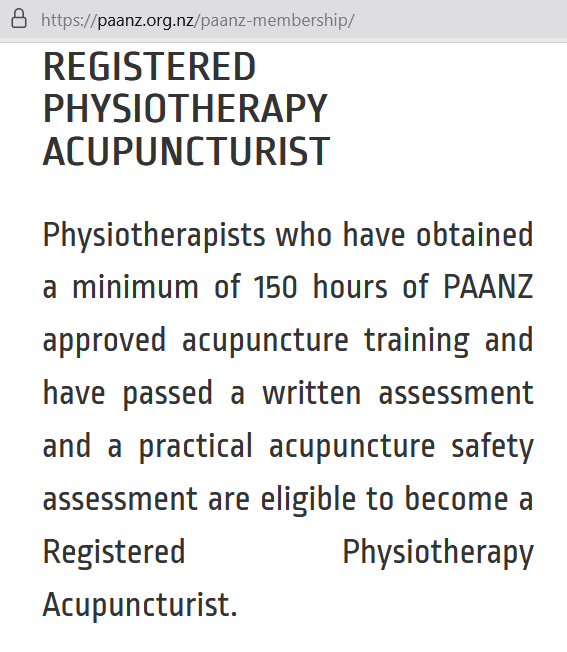
Accoding to the official website of The Physiotherapy Acupuncture Association of New Zealand (PAANZ) practitioners who have obtained a mere 150 hours of acupuncture training are eligible to become a Registered Physiotherapy Acupuncturist. While this may allow them to practise safely and effectively within certain musculoskeletal applications, there is a wast difference from the depth of training undertaken by professional acupuncturists.
Physiotherapists, chiropractors, and osteopaths are highly skilled in their primary disciplines, but their standard training generally does not include detailed topographic anatomy specific to acupuncture, advanced needling techniques, or the diagnostic framework of Traditional Chinese Medicine (TCM), including syndrome differentiation. Accurate TCM diagnosis is considered essential for achieving consistent treatment outcomes across the full range of acupuncture applications.
That said, some physiotherapists supplement their core qualification with extensive acupuncture training, including full-time degree-level programs lasting up to five years, comparable to the training of registered acupuncturists.
Standards of education for dry needling
Dry needling has no university-level education framework. It is normally delivered over a short-course training. Practitioners including massage therapists, registered nurses, occupational therapists, naturopaths, physiotherapists, chiropractors may not have the specific training. The course includes specific topographic anatomy, extensive needling technique training which is considered a norm for acupuncturists.
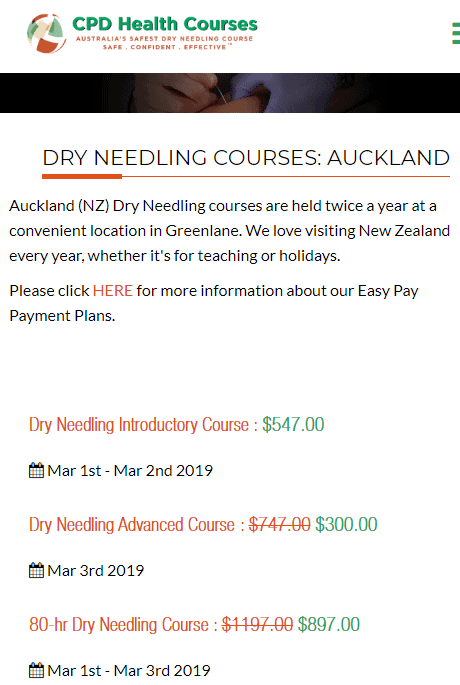
For example, at the time of writing this article, there is a 20 hour course offered in Auckland. And the longest course offered I could find is 80 hours! Would you trust a physiotherapist with an 80 hours training do to physiotherapy? Neither would I. And they don’t go beyond your skin.
“For patients’ safety, dry needling practitioners should meet standards required for licensed acupuncturists and physicians.” The American Alliance for Professional Acupuncture Safety (AAPAS) White Paper 2016 (CJ Integr med 2017)
Registered Pysiotherapy Acupuncturists
According to the webiste of The Physiotherapy Acupuncture Association of New Zealand (PAANZ), physiotherapists who have obtained as littele as 150 hours of acupuncture training are eligible to become a Registered Physiotherapy Acupuncturist.
