• Link to Facebook Link to Facebook Link to Facebook
  • Info for GPs
  • Our blog
  • Costs
Phone +64 9 486 5111
  • Success stories
  • Meet the Team
  • What we treat
    • Reproductive health
      • Fertility
      • IVF
      • PCOS
      • Miscarriage prevention
      • Endometriosis – Fertility
      • Male fertility
      • Herbs for Fertility
      • Fertility lifestyle
        • Fertility diet
    • Women’s health
      • Pregnancy Acupuncture
      • Pelvic pain/Period pain
      • Menopause
    • Pain/Injuries
      • Back pain
      • Migraines
      • Neck pain & headaches
      • Knee osteoarthritis
      • ACC injuries
    • Emotional balance
      • Anxiety, Stress
      • Depression
      • Insomnia
      • Fertility stress
  • Info for GPs
  • Costs
  • Contact
  • Menu Menu
The risk of dementia is approximately 85% higher when no acupuncture is received

Acupuncture and Dementia: How this treatment reduces the risks

New studies shed light on acupuncture’s potential to protect against dementia, particularly among those battling insomnia and migraines. Additionally, in those who develop the condition, electro-acupuncture almost halfs the risk of disability.

Acupuncture reduces risk of dementia in patients with insomnia

Chronic sleep problems can muddy the waters of cognitive health, increasing the risk of dementia over time. But acupuncture might just be the lighthouse for patients with insomnia, offering them protection. A very large new study, conducted by a team from China Medical University Hospital in Taiwan and published in the Journal of Traditional and Complementary Medicine, sheds light on acupuncture’s potential to protect against dementia, particularly among those battling insomnia.

The study aimed to investigate whether this TCM treatment is associated with a reduced risk of developing dementia in patients who suffer from insomnia.

The researchers collected real-world data from over 150,000 patients diagnosed with insomnia to conduct a propensity-score-matched cohort study. This approach carefully aligned two groups—one receiving acupuncture and the other not—ensuring that both were balanced in demographic and health characteristics, isolating the effects of this natural therapy on dementia risk. The meticulous work uncovered a striking 46% decrease in dementia risk for the acupuncture group. This means that the relative risk in those who did not receive acupuncture is 85% higher compared to the patients who received this treatment.

Acupuncture has long been recognised for its ability to promote relaxation and improve sleep, both crucial for cognitive health. The study suggests that regular sessions could help individuals with insomnia establish healthier sleep patterns, potentially fortifying their cognitive function and reducing risk of dementia.
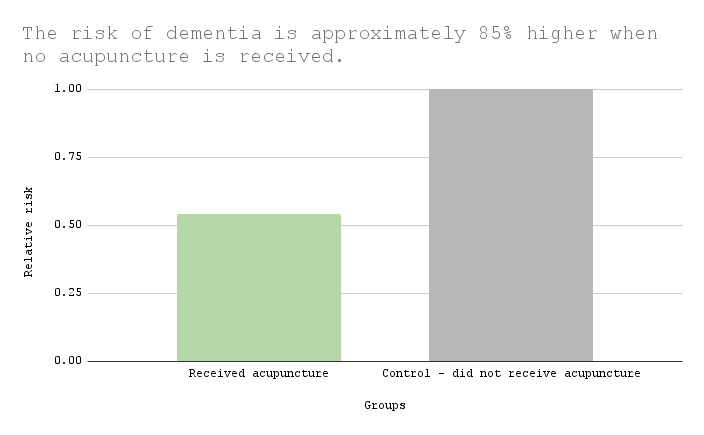
 

The risk of dementia is approximately 85% higher when no acupuncture is received


Acupuncture has long been recognised for its ability to promote relaxation and improve sleep, both crucial for cognitive health. The studies suggest that regular sessions could help individuals with insomnia establish healthier sleep patterns, potentially fortifying their cognitive function and reducing dementia risk. The study was published in Journal of Traditional and Complementary Medicine in May 2023.

Acupuncture reduces the risk of disability

This recent study investigated whether acupuncture therapy could reduce the risk of developing significant disability among patients diagnosed with dementia. Disability, defined in this research by the requirement for devices such as a urinary catheter, nasogastric tube, or tracheostomy tube, is a serious complication for which preventive measures are currently lacking.
The researchers performed a large, long-term analysis using a nationwide health database in Taiwan, looking at 9,760 newly diagnosed dementia patients. Patients were divided equally into groups that either received acupuncture treatment or did not. The findings demonstrated a significant association between acupuncture and better outcomes: dementia patients who received acupuncture treatment had a lower risk of disability development compared to those who did not.

This protective effect was substantial, the risk of disability development is approximately 53.85% higher for patients who do not receive acupuncture. Interestingly, electro-acupuncture, the kind we use at our rooms, was significantly more effective. The risk of disability development is approximately 1.96 times higher in patients who did not receive electroacupuncture compared to those who did. Importantly, this result was consistent across various subgroups, including patients of different ages, sexes, income levels, and those with underlying health conditions like diabetes, hypertension, or stroke. These results suggest that incorporating acupuncture could be a valuable part of care programs for dementia management.

Acupuncture for patients with migraines and dementia risk

Another significant study by the same author Cheng-Hao Huang and colleagues from Taiwan, used a similar approach to explore the effects of acupuncture in a different patient group. This study utilised Taiwan’s National Health Insurance Research Database to investigate the incidence of dementia in patients with migraine, who either received or did not receive acupuncture treatment. The results from this large-scale study revealed that patients with migraine who received acupuncture had a substantially lower risk of developing dementia, with an adjusted hazard ratio of 0.51. This suggests a 49% reduction in dementia risk among the acupuncture group compared to those who did not undergo this treatment. This robust evidence underlines the potential of acupuncture as a preventive treatment against dementia in individuals with migraine, further highlighting neuroprotective role of this natural approach.

Biological Mechanisms of Acupuncture in Alzheimer’s Disease

Research is starting to bring some clarity on how acupuncture might influence the progression of Alzheimer’s disease. A recent meta-analysis published in Translational Psychiatry (part of the Nature) provides a useful summary of what we know so far.

In experimental models, acupuncture has been shown to:

  • reduce amyloid-beta and tau — two proteins that can build up in the brain and disrupt how nerve cells communicate
  • lower neuroinflammation, the brain’s version of chronic inflammation that can gradually damage cells, and reduce oxidative stress, a form of cellular “wear and tear”
  • support synaptic function — the connections between brain cells that allow memories to form — and help protect neurons from dying off.

These findings point to a coherent biological pathway through which acupuncture could  influence neurodegeneration, rather than simply addressing symptoms.



How acupuncture helps dementia

Dementia – Acupuncture improves cognitive function

What is Dementia?

Have you ever wondered what dementia is? Well, let me break it down for you. Dementia is a condition characterized by a decline in cognitive abilities such as memory, thinking, and communication. It’s a gradual and progressive disorder that can make it difficult for individuals to carry out their daily activities and can significantly impact their quality of life.

Now, here’s the thing: there’s currently no cure for dementia. But there are treatments available that can help manage its symptoms and improve quality of life. So, while we may not have all the answers yet, there is hope for those affected by this condition. And with continued research, we may one day be able to find more effective treatments or even a cure.

The promise of Acupuncture

Let me tell you something fascinating: a recent study conducted at the department of Acupuncture in Beijing Hospital of TCM suggests that acupuncture might be a viable option for treating vascular dementia. Yes, you heard that right! This ancient practice could potentially improve cognitive function and quality of life for those grappling with this debilitating condition.

During the study, researchers assessed the cognitive function and quality of life of participants before and after receiving acupuncture treatment. They also measured levels of 8-OHdG, a marker of oxidative stress in the urine. And guess what? The results were nothing short of remarkable! Participants not only showed a reduction in 8-OHdG levels but also experienced improved cognitive function and quality of life.

Now, don’t get too carried away just yet, because this study was conducted in a single center and with a relatively small sample size. So, further research is necessary to validate these findings and determine the optimal acupuncture treatment protocol for vascular dementia patients. Nevertheless, this study certainly raises some exciting possibilities about the potential of acupuncture to positively impact our health and well-being.

The findings were published in the current issue of the Journal of Traditional Chinese Medicine [2012, 32(2):199-202].


Update 2021:
A recent systematic review published in European Journal of Integrative medicine summarised 137 studies (randomised controlled trials) amassing a total of 9012 participants. Their conclusion is promising:  “The available evidence seems to support the beneficial effects of acupuncture at effective rate, cognitive performance and activities of daily living for people with dementia.” The researchers call for studies to further confirm these effects.

Chinese medicine eases dementia

Dementia is a progressive neurodegenerative disorder that affects memory, thinking, and behavior. It is a debilitating disease that affects millions of people worldwide, and there is currently no cure. Traditional Chinese medicine has been used for centuries to treat various ailments, and ba wei di huang wan (BDW) is a Chinese herbal medicine which may offer hope.

In this study, published in Journal of the American Geriatrics Society, Japanese researchers aimed to evaluate the effectiveness of BDW in the treatment of dementia.

The results were nothing short of amazing! The patients who received BDW showed significant improvements in cognitive function and activities of daily living. On the other hand, the placebo group showed no significant change.

But that’s not all! The study also showed a significant decrease in the pulsatility index in the internal carotid artery in the BDW group, indicating an improvement in cerebral blood flow. However, the improvement was only observed during the treatment period, and the scores declined to the baseline level eight weeks after they stopped the treatment.

In conclusion, this study provides evidence of the benefits of BDW in the treatment of dementia. However, the study has some limitations, including a small sample size, short treatment period, and lack of long-term follow-up. Further studies with larger sample sizes, longer treatment periods, and long-term follow-up are needed to confirm the effectiveness of BDW in the treatment of dementia. Nonetheless, this study provides valuable information on the potential benefits of traditional Chinese medicine in the treatment of dementia.

BaWeiDiHuangWan is available through our clinic.

The abstract of the study can be found here.

►Fertility success stories

Success stories:

Achilles tendinitis anxiety arthritis back pain Bell's palsy depression Endometriosis hay fever injuries interstitial-cystitis migraines and headaches neck pain Neuropathy pain pain-free acupuncture pcos pelvic pain performance enhancement posture correction prenatal seroma SIJ stress management
Meet the teamBook an appointment
Call (09) 486 5111
  • Link to Facebook Link to Facebook Link to Facebook
  • Dr Vitalis Acupuncture Auckland
  • Contact
  • Disclaimer
Scroll to top Scroll to top Scroll to top